
LITERACY AND Oracy
Literacy mission statement
‘Literacy is fundamental not only within our knowledge curriculum, but also in the building of moral, social and cultural capital. Championing excellence in literacy is the responsibility of everyone at Honywood School in order to ensure the future successes of all learners in school and in later life.’
Reading is such an essential skill in school because it provides the gateway to our curriculum, but the importance of reading far outreaches the classroom. Being able to read confidently is key to being a successful learner in all other areas of life. The statistics around the impact of low literacy skills are shocking. For example, those with low literacy skills are more than twice as likely to be unemployed than those who can read beyond the most basic of levels. Sadly, as many as 1 in 6 adults in England have ‘very poor literacy skills’, hence the promotion of reading must always remain pivotal within any school's priorities. We are dedicated to successfully delivering an effective literacy programme in all areas of the curriculum. All learners have a right to be competent readers, writers and communicators in order to reach their academic potential and be successful in their futures.
Honywood School is committed to raising the standards of literacy for all of our learners. We do this through seven key strands;
-
We prioritise ‘disciplinary literacy’ across the curriculum so that in each subject learners are taught how to read, write and communicate effectively in their subject.
-
We provide targeted vocabulary in every subject to help learners access and use academic language, prioritising the explicit teaching of tier 2 and 3 vocabulary.
-
We develop learners' ability to read academic texts by encouraging them to actively engage with what they are reading and using their prior knowledge to develop their reading comprehension.
-
We break down complex writing tasks and provide explicit instruction in how to improve writing in every subject.
-
We combine writing instruction with reading in all subject areas because both skills support the development of the other.
-
We provide opportunities for structured talk because oracy is a powerful driver of learning.
-
We provide high quality literacy interventions for struggling learners, by carrying out reading age tests alongside other assessments to match learners to appropriate support.
All staff contribute to this in their daily teaching and learning, learners can expect to be exposed to effective teaching and reinforcement of these skills around the school.
Reading in the curriculum
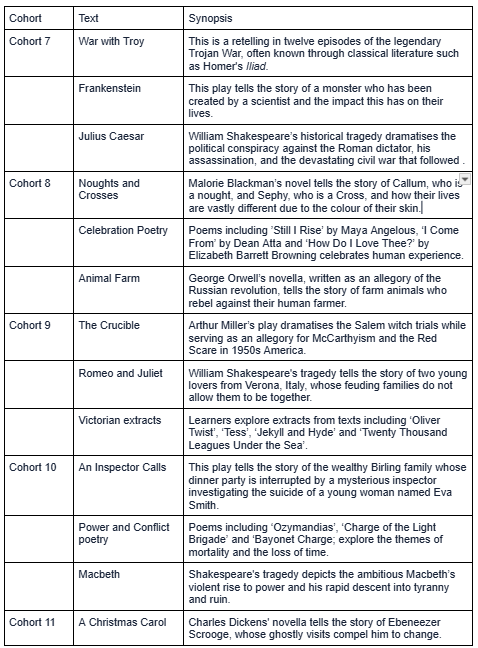
The following texts form the foundation for the English literature curriculum. We encourage all learners to engage fully in these texts to provide a well rounded introduction to academic literature, and also to promote all learners' moral and social capital.
LS5 Learning Group Time Reading
At least one LS5 session per week is allocated to reading during ‘Drop everything and read’ time (DEAR) or ‘Drop everything and listen’ time (DEAL).
The Key Stage 3 DEAL/DEAR programme provides a structured, engaging journey designed to foster a lifelong love of reading and develop critical literacy skills throughout the academic year.
Half Term 1: Learners start off the year with an exciting in-form competition, researching authors and blurbs to present and vote on their favourite book from the list given, followed by Learning Group Leader-led reading where learners follow along, tracking key vocabulary and completing targeted tasks.
Half Term 2: Learners are introduced to active reading strategies using the Reading Strategies Handbook to build deeper comprehension skills.
Half Term 3: Learners transition to independent reading, selecting books from the library, spinning stands, or the BorrowBox app, giving LGLs the opportunity to conduct one-on-one reading sessions.
Half Terms 4 & 5: The curriculum introduces play scripts, giving learners the chance to undertake roles in order to enhance their reading fluency, expression, and intonation.
Half Term 6: To end the year, learners unleash their creativity through progressive weekly reading and writing challenges. In each session, learners read and discuss an exemplar short story before crafting and sharing their own- starting with a one-sentence story in Week 1, expanding to a 50-word story in Week 2, a 100-word story in Week 3, and building from there.
The KS4 DEAL/ DEAR curriculum involves exposing learners to a plethora of different writers and formats, to broaden their reading horizons and engage them in the notion of reading for pleasure and curiosity. Each session begins with a big, overarching question to get learners thinking about the focus of the session, before they undergo 15-20 minutes of reading or listening. Each session ends with some deep, critical thinking time, dedicated to thinking about questions around three key areas: comprehension, analysis and connection to the wider world.
Half Term 1: DEAR - Technology and Social Media. Students consider the harmful consequences of a world that is dedicated to developing the capabilities of Technology and Social Media.
Half Term 2: DEAL - Individual Voice. Students are exposed to a range of speeches and interviews, considering the importance of having an authentic voice to express thoughts, feelings and experiences.
Half Term 3: DEAR - The Untold Stories. Students will uncover the secret figures hidden within well-known tales and events, considering their importance to the success or destruction.
Half Term 4: DEAL - True Crime and Unsolved Mysteries. Students will delve into the mind of a detective and try to solve a range of unsolved crimes.
Half Term 5: DEAR - Survival and Pushing Limits. Students will focus on key life skills, including perseverance, resilience and bravery. They will read a range of formats expressing the writer’s true fight for survival.
Half Term 6: DEAL - What Ifs. Students will consider what would happen to the world if things weren’t as they seem…
'Reading for success' - Literacy intervention programme
Across all subject areas and in every learning session, staff highlight the vocabulary needed to access their learning in the subject. This targeted vocabulary support helps all learners to be able to access and use academic language in their learning. Key vocabulary is shared with parents and carers for each topic area studied prior to the start of each term.
It is essential that we provide high quality literacy interventions for struggling learners, by carrying out reading age tests and other assessments to match learners to appropriate support. All KS3 learners are assessed using NGRT reading age assessments. From this, all teachers are fully informed of the learners’ reading ages and so can stretch, challenge and scaffold literacy appropriately during learning sessions. Where a learner has a reading age which is lower than their chronological age we instigate bespoke weekly small group support to help support progress in their reading ability, intended to develop their fluency, vocabulary and comprehension. In addition our Cohort 9 and Cohort 10 reading mentors support one to one reading with learners in a weekly session intended to develop reading confidence in our reluctant readers in the younger cohorts.
The SEND department uses assessment and multiple interventions to support learners identified to be struggling with literacy. The York Assessment of Reading for Comprehension assessments (YARC) is used to identify and measure the processing difficulties that impact on reading. YARC measures single word reading skills, but in addition, reading fluency, reading accuracy and reading comprehension. Where difficulties with reading processing are identified, learners are placed on intervention where appropriate and assistive technology may be employed, for example: Electronic reader (this has options to read whole text or highlighted information/words), Colour tint (this can be placed on the iPad and has a wide range of hues or tints), Dictate mode on Word (this has an exceptionally accurate dictation feature). Interventions for learners where phonic skills are not yet established (profound reading difficulties) are via either Toe by Toe, WASP or HORNET interventions. These are all evidenced based interventions, delivered at a high frequency (4 to 5 times each week for 10 mins). Learners with moderate reading difficulties are supported by the use of the IDL literacy intervention programme and/or reading comprehension activities to support literacy development.
Developing our physical and virtual Library
This year we intend to reconfigure our library as part of our drive to promote a culture of reading, and we continue to run regular book swap events. We appreciate everyone’s support in donating books so that all children can have access to physical reading material that appeals to them. If anyone has any good quality books or are willing to contribute financially to increasing our library stock, we would really appreciate your support.
In addition, included in our admissions pack when joining Honywood, all learners are automatically registered with Essex Libraries, receiving their physical card to access any library, and also gaining free access to BorrowBox. This is a digital lending service allowing the download of e-books, e-audiobooks, e-magazines, and e-newspapers. As all our learners have access to an iPad as a loan device, this gives them access at their fingertips, We feel that this is so important to make reading at home and in school as accessible as possible, as we know that very often a learner who does not enjoy reading just has not found the right book yet.
Spelling, punctuation and grammar
In English, SPaG is taught explicitly throughout the curriculum. Raising the standards of extended written communication is a key focus of whole-school literacy. We have high expectations of spelling, punctuation and grammar at Honywood, and this is reflected in our feedback policy across all subject areas.
Oracy & Public Speaking - Jack Petchey Speak Out Challenge
Each year a group of Cohort 10 learners participate in a Speak Out Challenge run by the Jack Petchey Foundation. The learners use the skills they have acquired during the day of workshops to deliver a presentation that they have prepared. Learners are encouraged, not only to stand up and speak in front of their peers, but to also consider their body language, changing tone and facial expressions whilst doing so. Each year our learners astound their peers with the difficult and personal topics that they tackle. This is linked to the speaking requirement of the AQA GCSE English Language examination.
TREE Awards
As part of the KS3 character development programme (TREE Awards), learners are encouraged to engage in opportunities which help them to develop and share their love of reading. For example, as part of their bronze award, they are required to read a chapter of a book to their class.
Promoting reading in school and at home
We know reading is an essential skill in school and in life, and strong literacy is a key indicator for future success. We will do all we can to promote reading in all aspects of your child's school life. We ask that all parents and carers do their best to support their reluctant reader at home.
Create a Reading-Friendly Environment:
-
Designate a quiet space: Encourage your child to find a comfortable, distraction-free spot where they can read without interruption.
-
Make reading visible: Have books, magazines, or e-readers readily available in your home. Seeing reading materials around can be a subtle but powerful encouragement.
-
Limit screen time: While digital resources are valuable, excessive recreational screen time can compete with reading. Encourage balanced use of devices.
Be a Reading Role Model:
-
Let them see you read: Whether it's a novel, newspaper, magazine, or even an online article, show your child that reading is a valued activity in your household.
-
Share what you're reading: Talk about books or articles you've enjoyed. Your enthusiasm can be infectious.
Talk About Books (and Beyond!):
-
Ask open-ended questions: Instead of "Did you read your book?", try "What's the most interesting thing you've read recently?" or "What's happening in the story you're reading?"
-
Discuss current events: Read news articles together or discuss topics of interest from different sources. This encourages critical thinking and engagement with non-fiction.
-
Explore different formats: Reading isn't just about novels. Encourage graphic novels, non-fiction, biographies, poetry, online articles, or even audiobooks. The goal is engagement with text in any form.
-
Connect reading to their interests: If your child loves gaming, suggest books about game design or fantasy worlds. If they're into sports, find biographies of athletes or articles about sports science.
Support Their Choices:
-
Allow choice: Let your child choose what they want to read, even if it's not what you would pick. The key is to foster enjoyment.
-
Visit libraries or bookstores together: Make it an outing to explore new titles and authors.
-
Don't force it: If a book isn't working for them, it's okay to put it down and find another. The aim is to make reading a positive experience, not a chore.
Why encourage your reluctant reader?
-
15.9% of all 16 to 24 year-olds are not in education, employment or training; Literacy is a big factor in this.
-
10 to 16 year-olds who read for pleasure, do better at school.
-
Reading books is the only out-of-school activity for 16-year-olds demonstrably linked to securing managerial or professional jobs.
-
There is overwhelming evidence that reading and understanding texts has a significant relationship to people’s life chances, and can even extend their life.